Time Is the Ultimate Multiplier
"Our favorite holding period is forever." — Warren Buffett
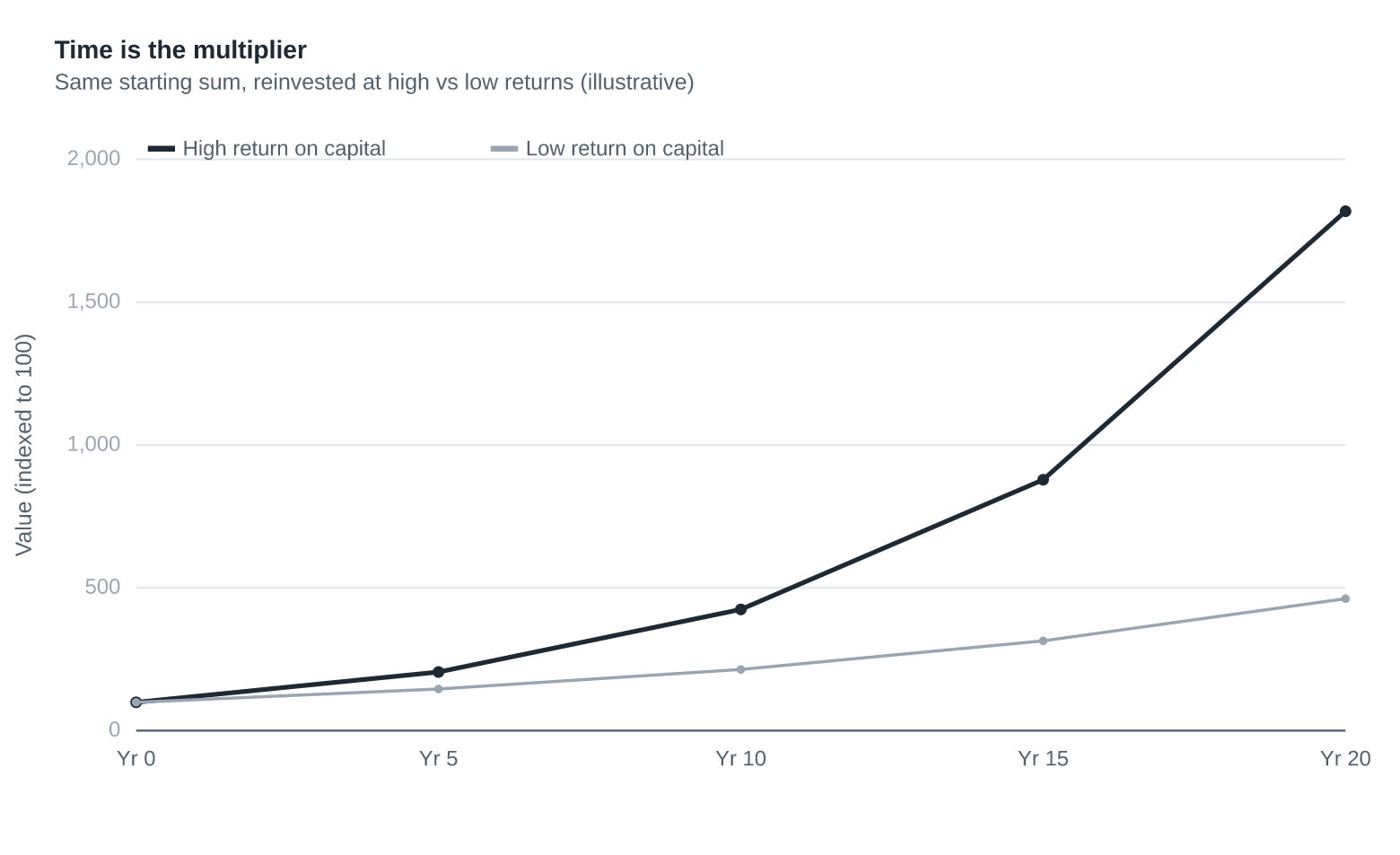
A business that earns, say, 20% on the capital it employs and reinvests those profits does not simply grow in a straight line — it compounds. Each year's gains become next year's base.
The point most investors miss is how decisively the holding period changes the outcome. A high-return business held for twenty years will usually beat a cheaper, lower-return business held for five — even if the cheaper one looked like the better bargain at the start. The quality of the business and the length of time you hold it tend to matter more than the entry discount.
This is why patience is not a personality trait in investing; it is part of the arithmetic. The longer a genuine compounder runs, the wider the gap it opens over a low-return alternative.
Illustrative example: the compounding gap
Picture the same sum invested in two businesses — one reinvesting at a high rate of return, one at a low rate — over twenty years. Early on the two look similar. By the end the high-return business has pulled far ahead, and the gap keeps widening. The mechanism is compounding, not stock-picking luck.
Educational only — not financial, tax, or investment advice, or a recommendation to take any particular course of action. Any names, figures, and examples illustrate a principle and are historical or simplified; past performance is not a reliable indicator of future results. Rules, tax treatment, and published figures change over time and may not reflect current policy. Wealth Diagnostics provides education and tools for financial advisers and their clients — seek licensed advice for your own circumstances before making any financial decision.