Think Like an Endowment
"Equity orientation and diversification are the bedrock of a long-term investment programme." — David Swensen, who ran Yale's endowment
A university endowment is built to pay out for generations. It never fully cashes in, so it can ride out bad years and keep most of its money in productive, growth assets. A retirement pot has more in common with that endowment than with a bank account: once you stop working it may still need to last thirty years or more.
That long horizon changes what "safe" means. Over a few months, shares are the risky asset and cash is the safe one. Over three decades, the position flips — cash quietly loses its purchasing power to inflation, while a diversified spread of shares has historically been the engine that grows and protects spending power.
For most of the last century, the accepted "prudent" rule was a balanced split — roughly 50/50, or 60/40, between shares and bonds. When David Swensen took charge of Yale's endowment in 1985, that is broadly how it was invested. He broke the rule. With his colleague Dean Takahashi, he pushed the equity orientation much further and spread the money across many more return drivers, arguing that a genuinely long horizon could carry more risk in exchange for more return. The approach reshaped how endowments invest.
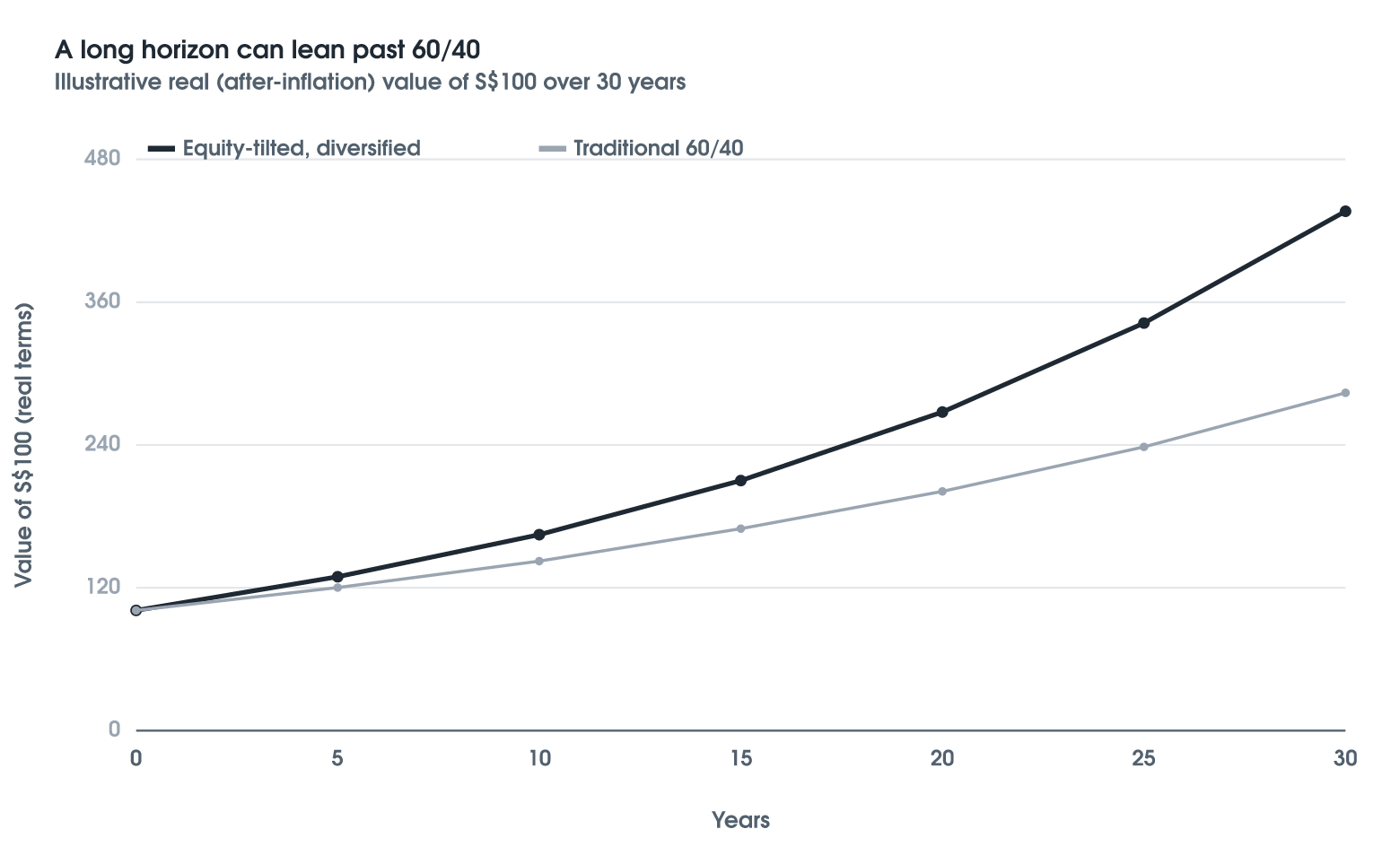
Illustrative example: the same S$100, two postures
Picture S$100 invested for thirty years, measured after inflation. A diversified, equity-tilted pot earning a modestly higher real return compounds well ahead of the traditional 60/40 mix — even though 60/40 was long considered the cautious choice. Same starting point; the posture decides the outcome. The figures are illustrative, not a forecast, and a larger equity tilt also means a bumpier ride.
The endowment mindset is not about taking wild risks. It is about matching the portfolio to the true time horizon — and letting a long runway, an equity tilt, and diversification do the work.
Educational only — not financial, tax, or investment advice, or a recommendation to take any particular course of action. Any names, figures, and examples illustrate a principle and are historical or simplified; past performance is not a reliable indicator of future results. Rules, tax treatment, and published figures change over time and may not reflect current policy. Wealth Diagnostics provides education and tools for financial advisers and their clients — seek licensed advice for your own circumstances before making any financial decision.