The Spending Rule
A smoothing rule lets an endowment spend steadily without raiding capital in the lean years. (The Yale spending rule.)
Once you accept total-return spending, the next question is how much to draw each year. Spend a flat percentage of the pot's latest value and your income lurches with the market — generous after a good year, painful after a crash, exactly when you can least afford to cut back.
Endowments solve this with a smoothing rule. Yale's, for instance, blends most of last year's spending (raised for the cost of living) with a smaller pull towards a target percentage of the current pot. Spending then drifts gently instead of swinging, and the capital base is protected because you never draw a fixed dollar amount straight into a falling market.
The same idea works for a household. Anchor next year's drawing mostly to this year's — adjusted for inflation — and let it adapt slowly to how the pot has performed.
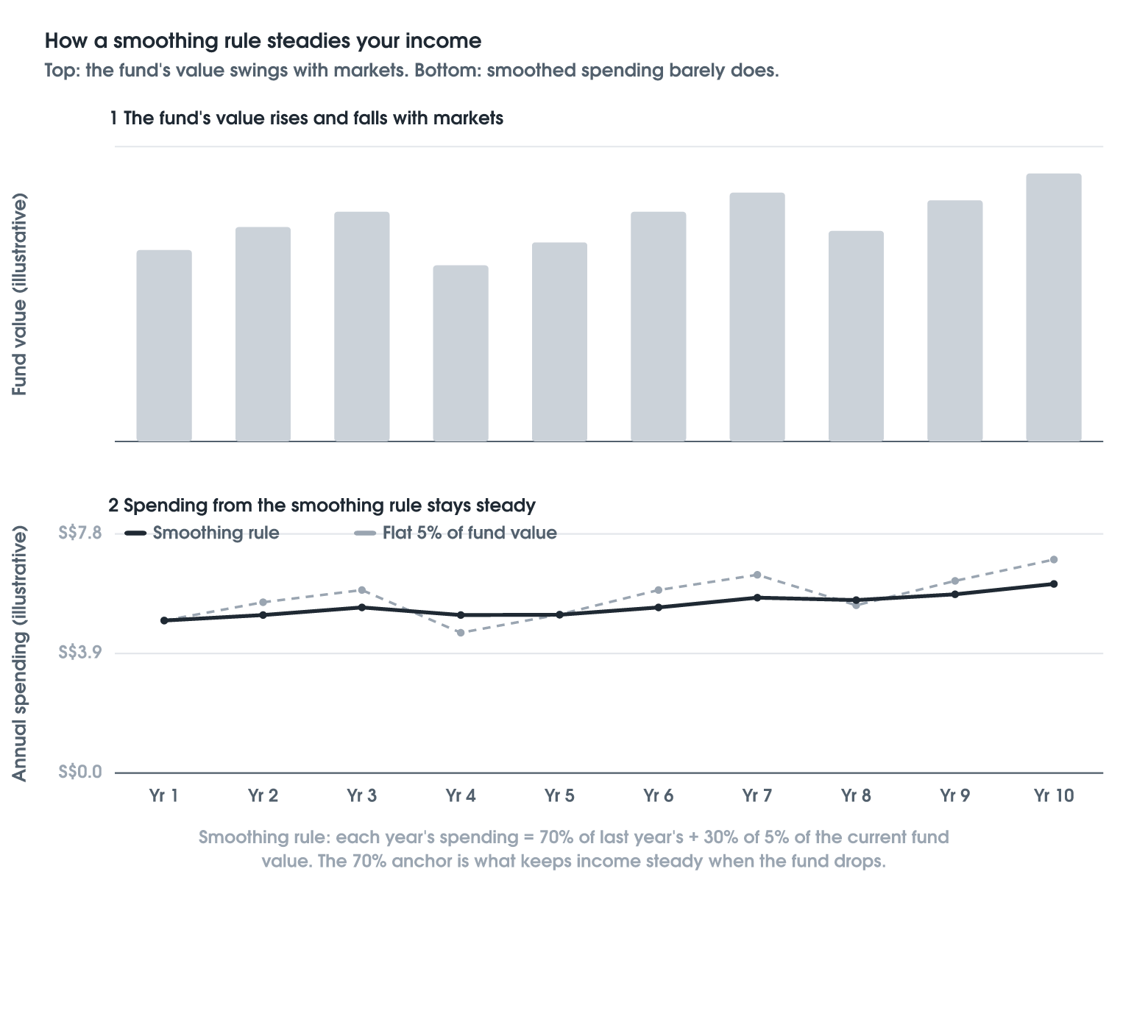
Illustrative example: steady versus lurching
The chart makes the mechanism visible. The top panel shows a fund whose value rises and falls with markets over ten years. The bottom panel shows two ways of drawing an income from it: one that simply spends a flat 5% of the fund's value each year — which lurches up and down with the market — and one that follows a smoothing rule. The smoothing rule sets each year's spending at 70% of last year's, plus 30% of 5% of the current fund value; that 70% anchor is what keeps the income steady when the fund drops. The figures are illustrative; the point is the far smaller swing.
A spending rule turns an unpredictable pot into a manageable paycheck — and stops a bad market from forcing a bad decision.
Educational only — not financial, tax, or investment advice, or a recommendation to take any particular course of action. Any names, figures, and examples illustrate a principle and are historical or simplified; past performance is not a reliable indicator of future results. Rules, tax treatment, and published figures change over time and may not reflect current policy. Wealth Diagnostics provides education and tools for financial advisers and their clients — seek licensed advice for your own circumstances before making any financial decision.