The Distribution of Outcomes: What Risk Really Means
"Investors are right to require higher returns from riskier assets. But they often forget that higher risk means a wider — and asymmetrically worse — range of possible outcomes, not just a higher expected return." — Howard Marks
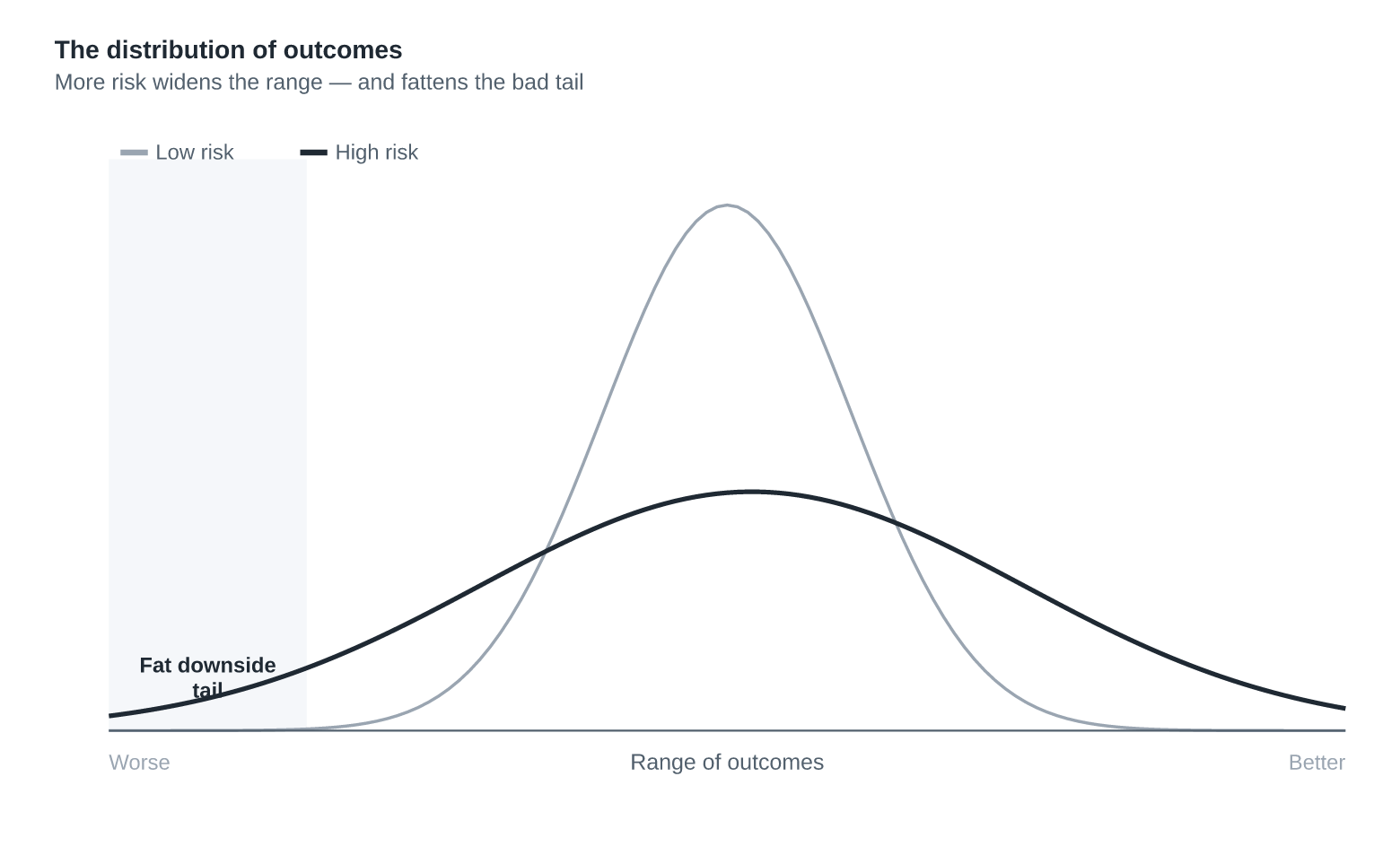
The comforting model of risk is a straight line: take more risk, earn more reward. Marks's more honest picture is different. As risk rises, three things happen at once:
- The expected return rises — this part the straight line gets right.
- The range of possible outcomes widens — results spread out far more.
- The downside tail gets disproportionately fat — the worst outcomes become both worse and more likely than a neat, symmetric picture suggests.
That third effect is what the straight line hides. At low risk, outcomes cluster tightly around the average. At high risk, the upside stretches but the floor can fall towards zero.
The practical implication is important: a high-risk investment with an attractive average expected return can still be a poor bet, if the bad tail is fat enough that the probability-weighted pain outweighs the probability-weighted gain. Position sizing, limits on leverage and diversification are not timidity — they are the rational response to that lopsided shape.
Illustrative example: building around the shape, not the average
Some investment strategies are designed expressly to find situations with a bounded downside and a long upside tail — accepting that you cannot predict which individual bets pay off, only that the shape of the distribution is favourable. The discipline is to manage the range of outcomes, not just the expected value.
Educational only — not financial, tax, or investment advice, or a recommendation to take any particular course of action. Any names, figures, and examples illustrate a principle and are historical or simplified; past performance is not a reliable indicator of future results. Rules, tax treatment, and published figures change over time and may not reflect current policy. Wealth Diagnostics provides education and tools for financial advisers and their clients — seek licensed advice for your own circumstances before making any financial decision.