Sinking Funds: Saving Ahead for Known Bills
A sinking fund turns a once-a-year shock into twelve quiet, painless set-asides.
Some costs are not emergencies — you can see them coming a year away — yet they still blow up the month they arrive. Annual insurance, road tax, school fees, the festive season, a planned holiday: each is predictable, and each lands as a lump that no single month's income comfortably absorbs.
A sinking fund fixes this by working backwards. Take the known cost, divide by the months until it is due, and set that amount aside every month into a separate, named pot. By the time the bill arrives, the money is already there. The annual S$1,200 premium becomes S$100 a month you never feel; the December trip is funded by January.
This is the modern version of the old envelope method, where people physically split cash into labelled envelopes for each purpose. The envelopes are now sub-accounts or savings "pots" in a banking app, but the psychology is identical: money given a name and a job is far harder to accidentally spend.
Sinking funds are the quiet workhorses of a calm financial life. They convert the predictable-but-lumpy into the steady-and-boring, which is exactly what you want your money to be.
Illustrative example: smoothing the lump
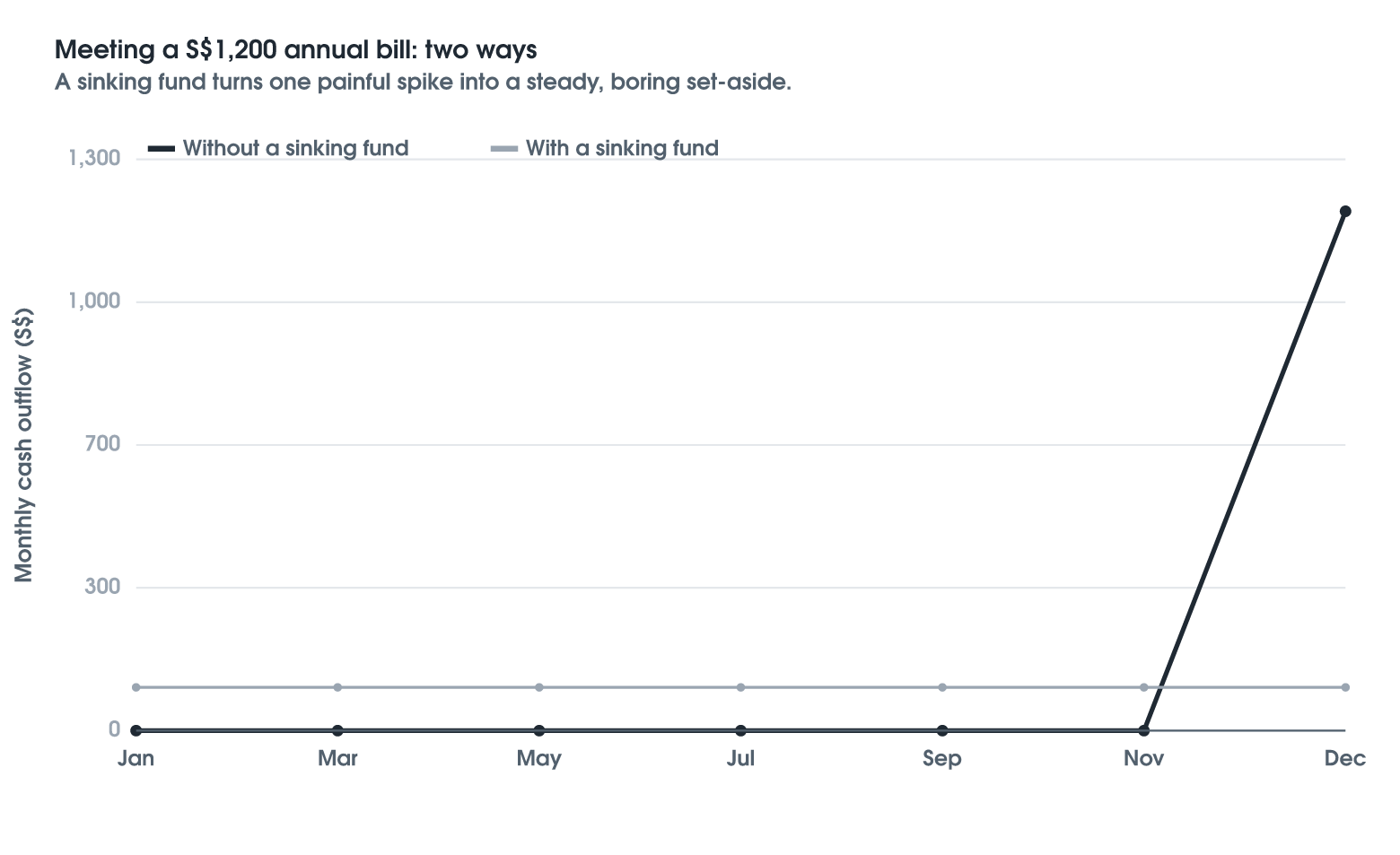
The chart contrasts two ways to meet the same annual bill. Without a sinking fund, outflow sits at zero for eleven months, then spikes painfully when the bill lands. With one, you set aside a small, steady amount every month and the spike disappears. Same total cost — but one path is a cliff and the other is a gentle, manageable slope.
Educational only — not financial, tax, or investment advice, or a recommendation to take any particular course of action. Any names, figures, and examples illustrate a principle and are historical or simplified; past performance is not a reliable indicator of future results. Rules, tax treatment, and published figures change over time and may not reflect current policy. Wealth Diagnostics provides education and tools for financial advisers and their clients — seek licensed advice for your own circumstances before making any financial decision.