Providing for a Child with Special Needs
The hardest planning question for many parents is not "what do I leave?" but "who looks after it, and them, after I am gone?" (Care that must outlast the caregiver.)
For a parent of a child with special needs, estate planning carries a weight no document fully lifts: the worry of who will provide once you no longer can. An outright inheritance is often the wrong tool — a lump sum left to someone who cannot manage money can be lost, mismanaged, or exploited, and may disrupt the support they rely on.
A special needs trust is built for exactly this. Money is held and managed by a trustee and released over the beneficiary's lifetime for their care and living needs, on the terms you set. It turns a one-time inheritance into a managed, lasting stream of support, with someone accountable for it.
Singapore has a dedicated, low-cost option in the Special Needs Trust Company (SNTC), a non-profit set up with government support precisely so that ordinary families — not just wealthy ones — can put such a trust in place. It offers lower set-up and management costs than a private trust, and works alongside a care plan describing your child's needs, routines and wishes, so that future caregivers understand the person, not just the money.
Around this, the rest of the plan matters too: naming a guardian if the child is a minor, coordinating CPF and insurance nominations to feed the trust rather than pass outright, and writing down the practical knowledge only you currently hold.
This is a situation where professional advice is well worth its cost. The aim is continuity — that the care you give now carries on, structured and funded, after you are gone.
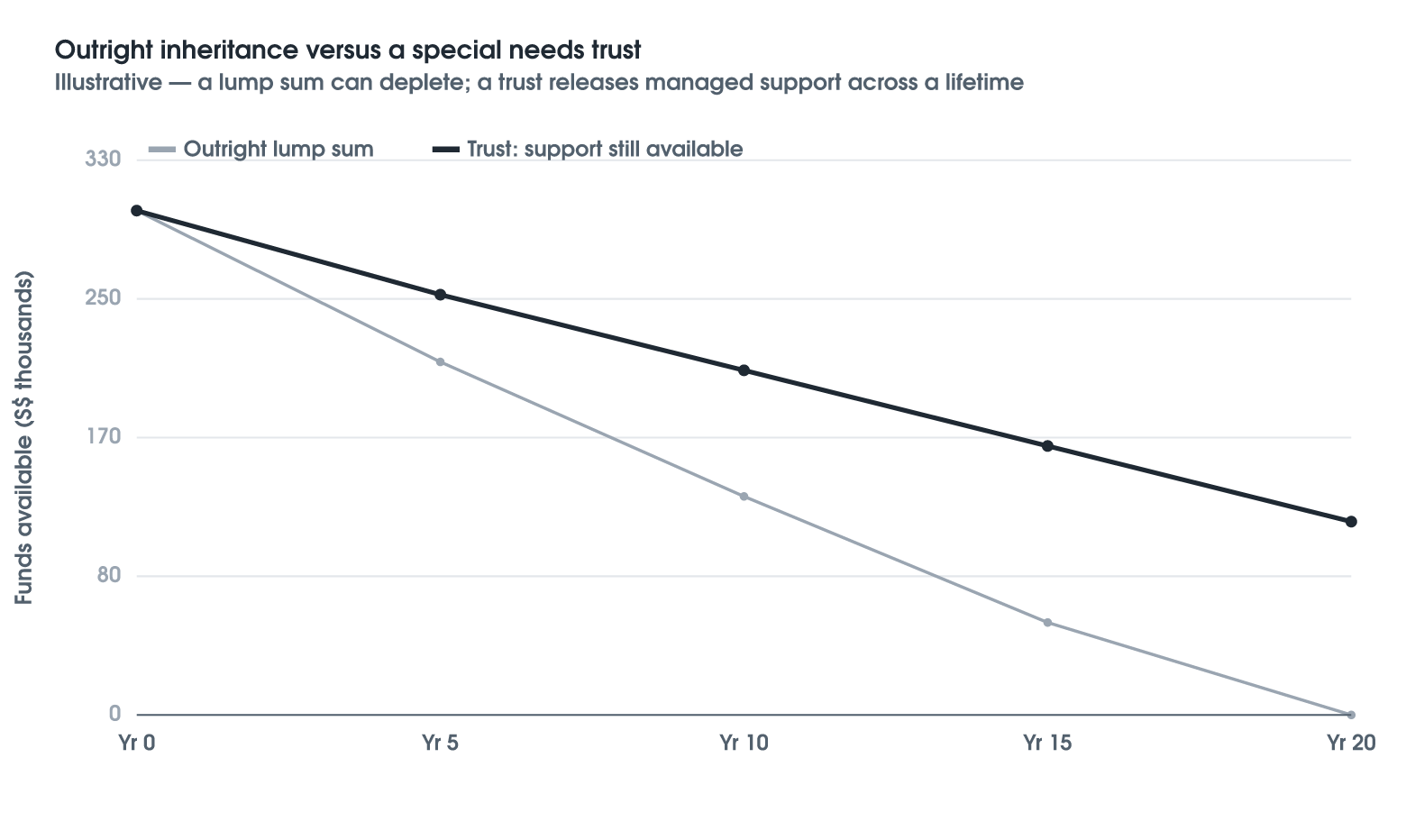
Illustrative example: outright inheritance versus a special needs trust
The chart contrasts the two approaches over time — a lump sum that can be depleted or mismanaged, against a trust that releases managed support across the beneficiary's life. For a dependant who cannot manage money, the structured path is what makes the provision last.
Educational only — not financial, tax, or investment advice, or a recommendation to take any particular course of action. Any names, figures, and examples illustrate a principle and are historical or simplified; past performance is not a reliable indicator of future results. Rules, tax treatment, and published figures change over time and may not reflect current policy. Wealth Diagnostics provides education and tools for financial advisers and their clients — seek licensed advice for your own circumstances before making any financial decision.