Passive vs Active — the Long Trend
"Don't look for the needle in the haystack. Just buy the haystack." — John C. Bogle, founder of Vanguard
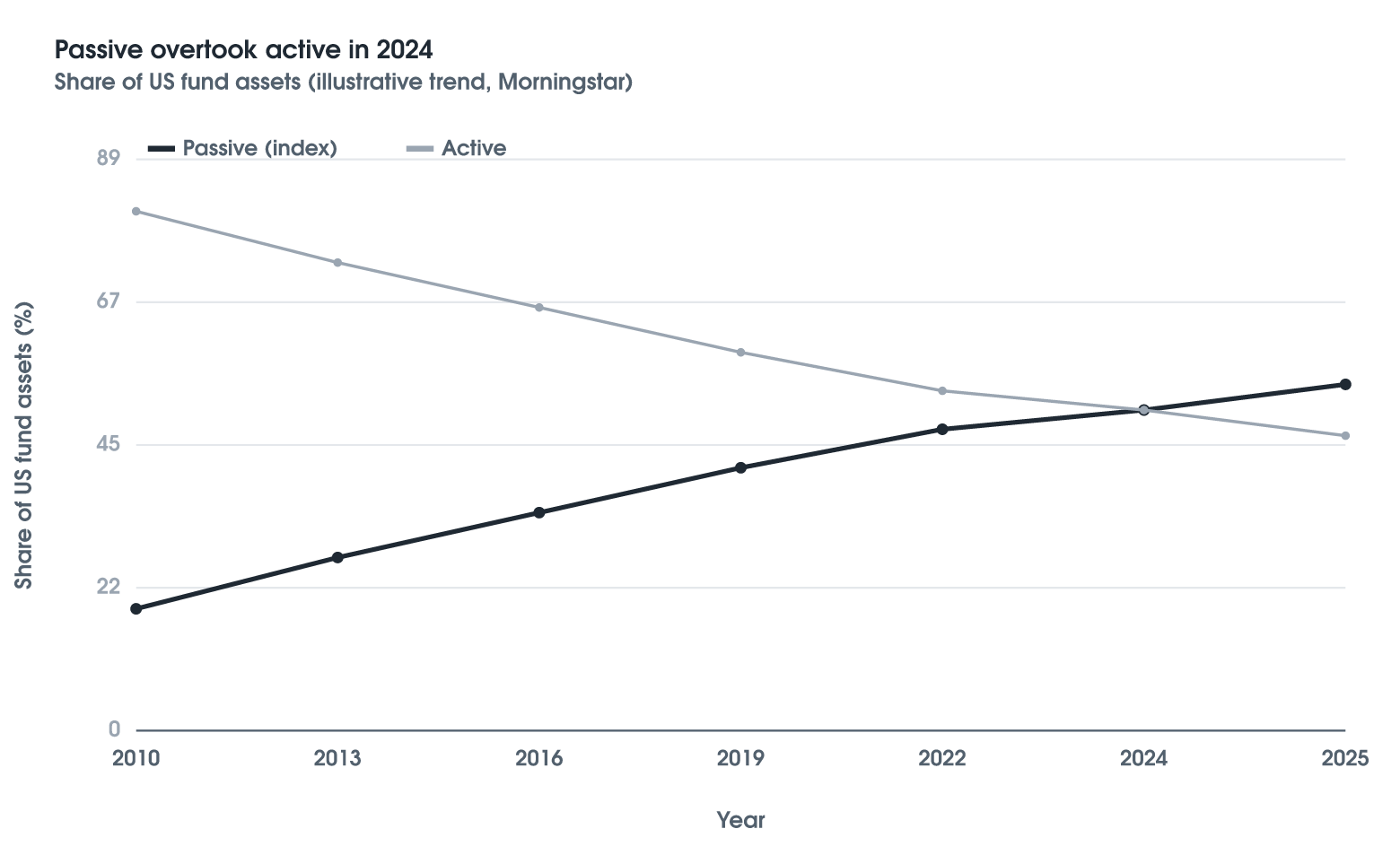
For decades, low-cost index (passive) funds have steadily taken money from active managers. The milestone arrived in 2024, when US passive funds' assets overtook active ones for the first time; by late 2025 passive held over US$19 trillion against active's roughly US$16 trillion.
The case for passive is strong: low cost, broad diversification, simplicity, and the SPIVA evidence that most active funds lag. The case for active is narrower but real: the chance — not the promise — of outperformance, more room to add value in less-researched corners, and a manager who can sidestep obvious trouble.
Passive itself has evolved. The first index funds simply tracked a market-capitalisation index — holding companies in proportion to their size. Today "passive" also covers funds built on other rules: equal-weighting every holding, weighting by fundamentals such as profits or dividends, or tilting towards factors like value or low volatility (often called "smart beta"). They remain rules-based and low-touch, but the rule is no longer always "just track the index" — so two passive funds can behave quite differently.
A newer debate sits on top. As the shareholder base becomes mostly passive, who sets prices? Index funds do not judge value; they buy in proportion to size. Critics such as Michael Burry warn this could dull price discovery and funnel money into the largest companies. Defenders counter that active managers still set prices at the margin, and that margin is large. It is a genuine, unsettled question — worth watching, not panicking over.
Illustrative example: the crossover
The chart shows passive's rising share of US fund assets crossing the halfway mark around 2024, with active's share falling to meet it. For most retirement savers a low-cost core remains sensible — while staying mindful of how much weight a handful of giant index constituents now carry.
Educational only — not financial, tax, or investment advice, or a recommendation to take any particular course of action. Any names, figures, and examples illustrate a principle and are historical or simplified; past performance is not a reliable indicator of future results. Rules, tax treatment, and published figures change over time and may not reflect current policy. Wealth Diagnostics provides education and tools for financial advisers and their clients — seek licensed advice for your own circumstances before making any financial decision.