Margin of Safety: The Right Tool for Each Outcome
Leave room for error — because the one risk you cannot recover from is the one that ends the game. (Margin of safety, in a line.)
Most of this pillar has been about specific products. This post is about the idea beneath all of them: a margin of safety. The principle is simple — because the future is unpredictable, you deliberately leave room for things to go wrong, so that when they do, you can absorb them and carry on.
Insurance is one expression of that idea, but not the only one. The mistake is to think any single tool can cover the whole range of what life might deal you. It cannot. A sound plan layers several, each suited to a different part of the range.
At the extreme bad end sit the rare, severe shocks — an early death, a disabling illness, a major hospital bill — losses so large that no savings could absorb them in time. These belong to insurance, which transfers them to a pool for a small, certain premium.
Closer in are the ordinary bumps: a job gap, a broken appliance, an unexpected bill. These belong to cash — an emergency fund you can reach instantly without selling anything. Beyond that, money you will not need for a few years can sit in bonds, which trade some growth for stability. And money for the long run belongs in equities, which ride out the ups and downs to grow wealth over decades.
Seen this way, the three jobs of money from the start of this pillar — save, invest, insure — are simply how you build a margin of safety across the whole range of outcomes. The aim is not to predict the future, but to be ready for it, whichever way it turns.
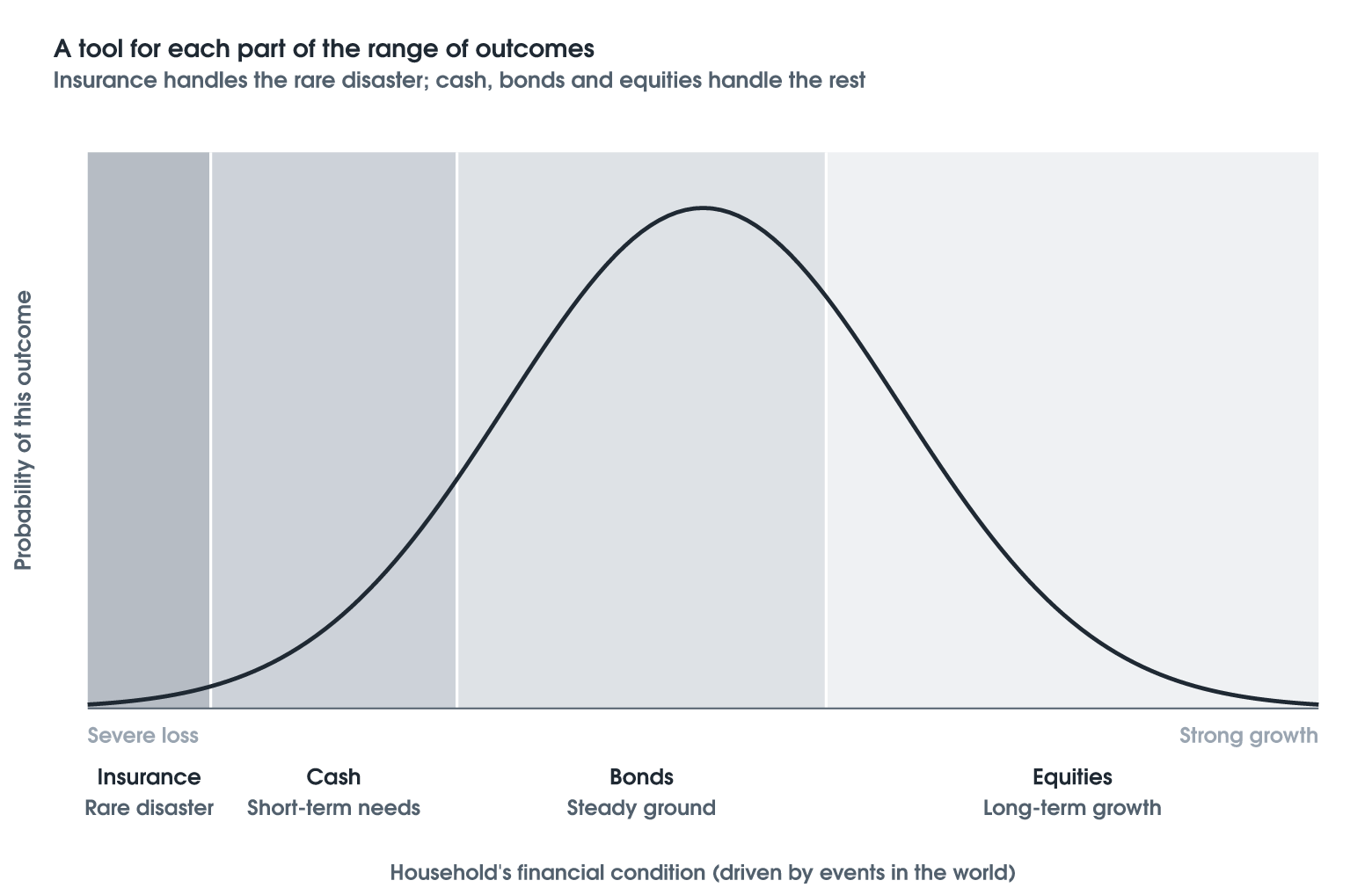
Illustrative example: a tool for each part of the range
The chart spreads the range of outcomes from severe loss to strong growth and maps each part to the tool that handles it — insurance for the rare disaster, cash for short-term needs, bonds for steady ground, and equities for long-term growth. Together they cover the whole curve, not just the middle.
Educational only — not financial, tax, or investment advice, or a recommendation to take any particular course of action. Any names, figures, and examples illustrate a principle and are historical or simplified; past performance is not a reliable indicator of future results. Rules, tax treatment, and published figures change over time and may not reflect current policy. Wealth Diagnostics provides education and tools for financial advisers and their clients — seek licensed advice for your own circumstances before making any financial decision.