Laddering: Match Cover to a Falling Need
Buy the cover you need for as long as you need it — and not a year more. (The laddering idea.)
Earlier we saw that the need for life cover usually peaks in the middle years and falls toward retirement. Laddering is the technique that matches your cover to that falling shape, instead of paying for a flat amount long after the need has gone.
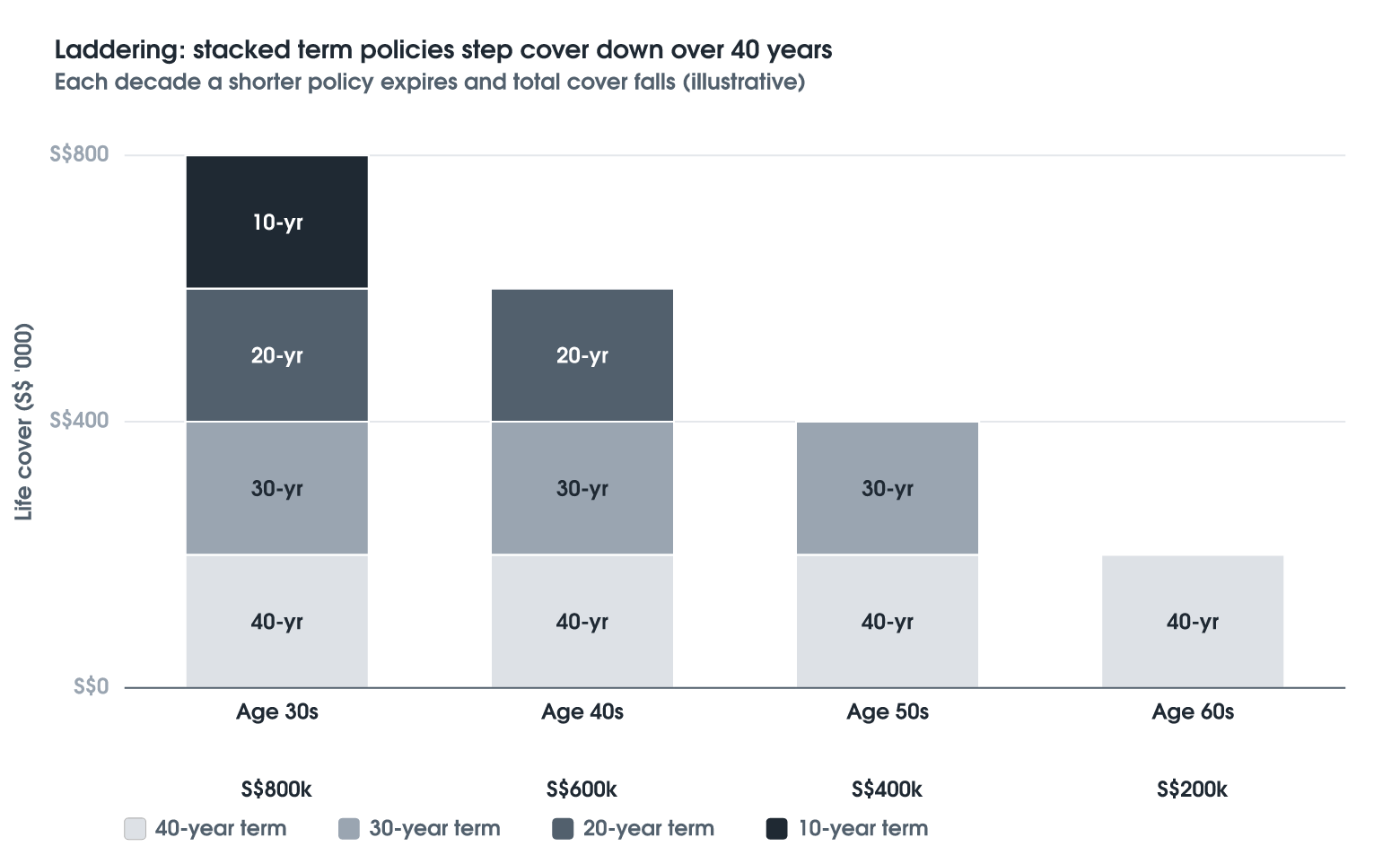
The method is simple. Rather than one large policy running for thirty years, you hold several term policies of different lengths that overlap — for example a thirty-year policy, a twenty-year policy and a ten-year policy stacked together. In the early years all three are in force, giving you the most cover when the need is greatest. As each shorter policy expires, your total cover steps down — roughly tracking the shrinking need.
The payoff is cost. You stop paying for cover you no longer need at each stage, so over the full period laddering is usually cheaper than one large, level policy held the whole way.
It does mean managing a few policies rather than one, and timing the rungs to your milestones — when the mortgage clears, when the youngest child finishes studying. But for households whose needs clearly decline, it is an efficient way to stay well covered without overpaying.
Illustrative example: cover that steps down with the need
The chart stacks several term policies of different lengths across four decades. Early on all of them are in force, giving the most cover when the need peaks. As each shorter policy expires, a layer drops away and total cover steps down — from S$800,000 in your thirties to S$200,000 in your sixties — roughly tracking the falling need, with no premium spent on cover you have outgrown.
Educational only — not financial, tax, or investment advice, or a recommendation to take any particular course of action. Any names, figures, and examples illustrate a principle and are historical or simplified; past performance is not a reliable indicator of future results. Rules, tax treatment, and published figures change over time and may not reflect current policy. Wealth Diagnostics provides education and tools for financial advisers and their clients — seek licensed advice for your own circumstances before making any financial decision.