Knowing When You Have Enough
"There is no reason to risk what you have and need for what you don't have and don't need." — Morgan Housel, The Psychology of Money (2020)
In a chapter titled "Never Enough", Morgan Housel describes the most dangerous financial trait of all: a goalpost that moves with every gain. Earn more, and "enough" quietly redefines itself upwards; reach the target, and the target relocates. The result is a treadmill where rising income never produces rising satisfaction, because the finish line keeps retreating.
The cost of not knowing when you have enough is not just a vague restlessness. It is what pushes people who are already comfortable to take needless risks, overwork, or over-leverage — chasing a number that will move again the moment they reach it. Housel's point is that the skill of saying "this is enough" is worth more than another increment of income, because it is the only thing that lets you actually enjoy what you have.
This does not mean abandoning ambition or settling early. It means defining, deliberately and in advance, what "enough" looks like for you — a level of spending, security, and freedom that you will recognise when you reach it — and then refusing to let the number drift just because your income did.
A budget is one of the few tools that makes "enough" concrete. When you decide what your money is for, you also decide, quietly, when you have arrived.
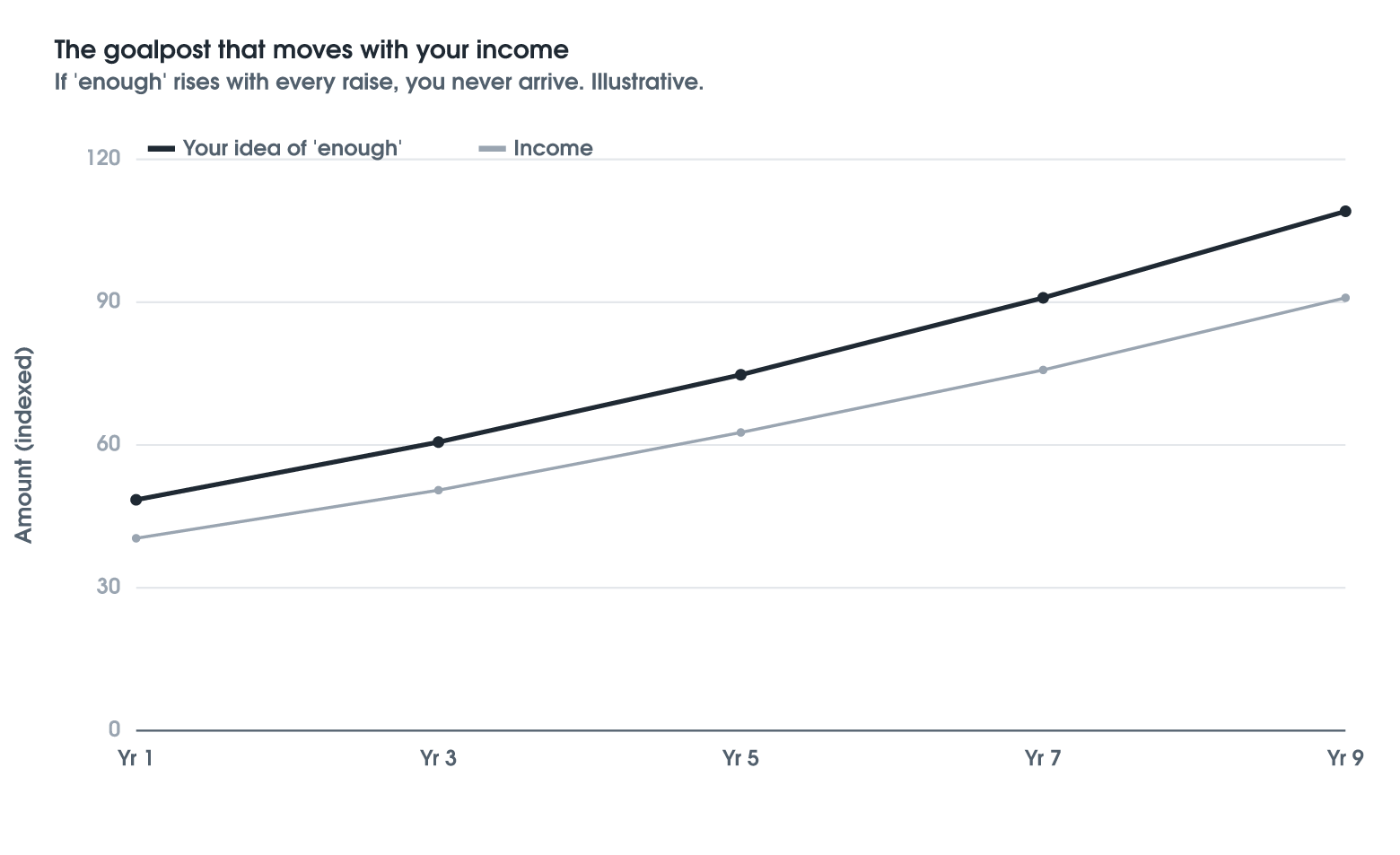
Illustrative example: the goalpost that keeps moving
The chart shows income rising over time with one's idea of "enough" rising in lockstep just above it — so the gap, and the sense of arriving, never closes. Fixing your definition of enough is what finally lets income overtake desire, and contentment catch up.
Educational only — not financial, tax, or investment advice, or a recommendation to take any particular course of action. Any names, figures, and examples illustrate a principle and are historical or simplified; past performance is not a reliable indicator of future results. Rules, tax treatment, and published figures change over time and may not reflect current policy. Wealth Diagnostics provides education and tools for financial advisers and their clients — seek licensed advice for your own circumstances before making any financial decision.