Investment-Linked Policies: How They Work
One product doing two jobs tends to do neither as cheaply. (The core critique.)
An investment-linked policy (ILP) combines life insurance with an investment fund in a single plan. Your premium is split: part pays for the insurance cover, part is invested in funds you choose, and part covers the policy's charges. The cash value rises and falls with the funds.
The appeal is convenience — protection and investing in one place, with a single payment. For some, the structure also enforces a savings habit they might not keep otherwise.
The critique is about cost and clarity. Because an ILP bundles three things, its charges — insurance costs, fund fees and distribution costs — are layered and not always easy to see. Insurance charges typically rise with age, which can eat into the investment portion in later years. And the investment performance is rarely better than what you could get by investing directly in low-cost funds.
This is why the recurring advice is to consider unbundling: buy term insurance for the protection, invest separately in low-cost funds, and keep each job visible and cheap. An ILP is not always the wrong answer — but it should be chosen with eyes open to its fees, not bought as a default.
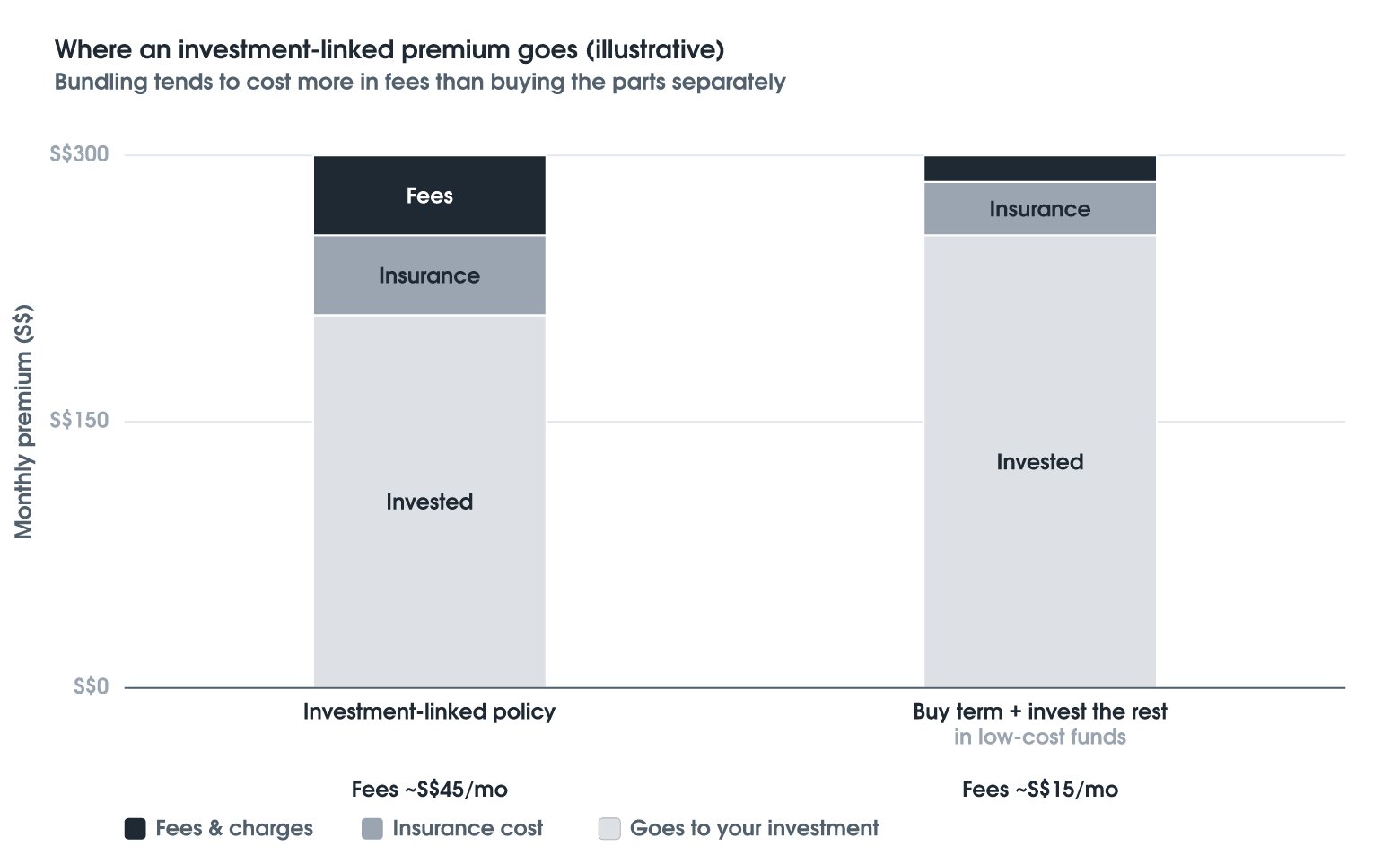
Illustrative example: where the premium goes
The chart traces an illustrative monthly premium through an ILP and through a buy-term-and-invest-the-rest alternative. In both, money goes to your investment, to insurance cost and to fees — but bundling tends to leave more in fees, so less of each dollar reaches your investment.
Educational only — not financial, tax, or investment advice, or a recommendation to take any particular course of action. Any names, figures, and examples illustrate a principle and are historical or simplified; past performance is not a reliable indicator of future results. Rules, tax treatment, and published figures change over time and may not reflect current policy. Wealth Diagnostics provides education and tools for financial advisers and their clients — seek licensed advice for your own circumstances before making any financial decision.