Why a Plan Beats No Plan — Even When It Changes
"Plans are useless, but planning is indispensable." — commonly attributed to Dwight D. Eisenhower
A common objection to budgeting is that life is unpredictable, so why bother? The car breaks down, a bonus lands, a job changes — and the neat plan from January no longer fits. If the plan will be wrong, the thinking goes, what is the point?
The point is the planning, not the plan. A budget's value is not that it predicts the year correctly; it never will. Its value is that it gives you a baseline — a clear picture of what you intended — so that when reality diverges, you can see the gap and decide what to do. Without a plan, an unexpected cost is just a vague worry. With one, it is a known deviation you can absorb, offset, or accept on purpose.
A plan also makes good surprises count. An unbudgeted bonus, with no plan, dissolves into ordinary spending. Against a plan, it has somewhere obvious to go — the buffer, a debt, the savings rate. The plan turns luck into progress.
So hold the plan firmly enough to steer by, and loosely enough to revise. Expect to adjust it monthly. The aim is not a perfect forecast; it is a steady hand on the wheel when the road bends.
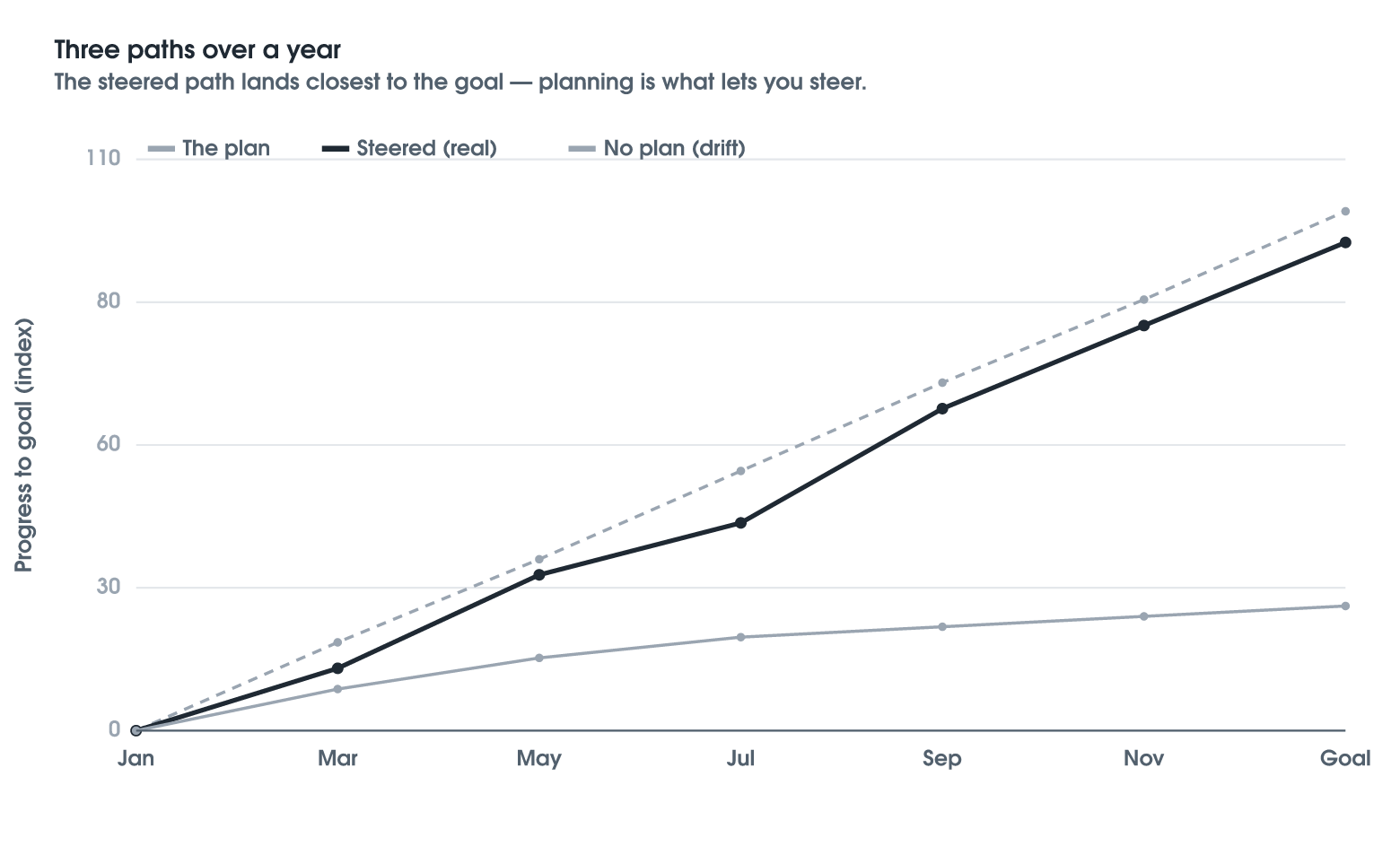
Illustrative example: planned, adjusted, and adrift
The chart shows three paths over a year: the original plan, the real path that diverges but is steered back toward the goal, and the no-plan drift that wanders off. The steered path rarely matches the plan exactly — yet it lands far closer to the goal than drifting ever does. Planning is what lets you steer.
Educational only — not financial, tax, or investment advice, or a recommendation to take any particular course of action. Any names, figures, and examples illustrate a principle and are historical or simplified; past performance is not a reliable indicator of future results. Rules, tax treatment, and published figures change over time and may not reflect current policy. Wealth Diagnostics provides education and tools for financial advisers and their clients — seek licensed advice for your own circumstances before making any financial decision.