Critical Illness Cover: Early-Stage vs Late-Stage
Hospital cover pays the medical bill; critical-illness cover pays for everything else. (A different job.)
A serious diagnosis brings two financial shocks: the treatment costs, and the months or years of reduced income and added expense around recovery. Hospital insurance handles the bills. Critical-illness cover does something different — it pays a cash lump sum on diagnosis, to spend however you need.
The key distinction is the stage at which it pays. Late-stage (or "severe-stage") cover pays the full sum only once an illness reaches an advanced, clearly defined stage. It is cheaper, because the trigger is narrower.
Early-stage cover pays out — often a partial sum — when an illness is caught at an earlier point. It costs more, because it pays sooner and on more conditions, but it can deliver money when treatment begins rather than only when things are severe.
Neither is automatically right. Early-stage cover gives you funds when they may matter most, at a higher premium; late-stage cover is leaner protection against the worst outcomes. Many people hold a core of late-stage cover and add early-stage cover if the budget allows.
The amount matters as much as the type: critical-illness needs are often sized at a few years of income, to buy time without forcing a return to work too soon.
Illustrative example: when the payout lands
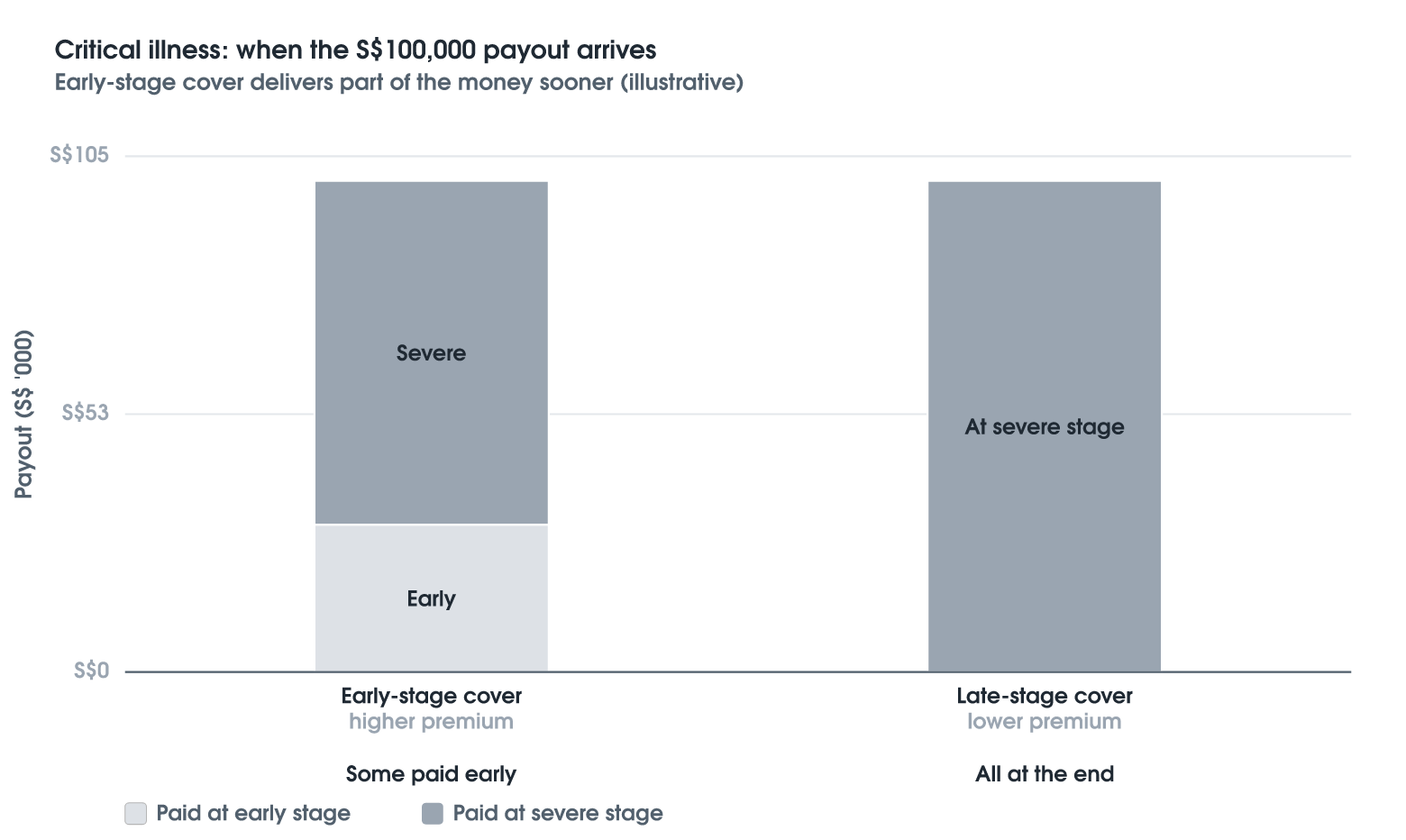
The chart shows when a S$100,000 payout arrives. Late-stage cover pays the whole sum only at an advanced stage; early-stage cover delivers part of the money on an earlier diagnosis, when treatment begins. Both can total the same — the difference is timing, and early-stage cover costs more for it.
Educational only — not financial, tax, or investment advice, or a recommendation to take any particular course of action. Any names, figures, and examples illustrate a principle and are historical or simplified; past performance is not a reliable indicator of future results. Rules, tax treatment, and published figures change over time and may not reflect current policy. Wealth Diagnostics provides education and tools for financial advisers and their clients — seek licensed advice for your own circumstances before making any financial decision.