Black Swans: What You Don't Know Will Hurt You
"The Black Swan is the outlier, the unexpected, the event that carries extreme impact — and that we construct explanations for after the fact." — Nassim Taleb
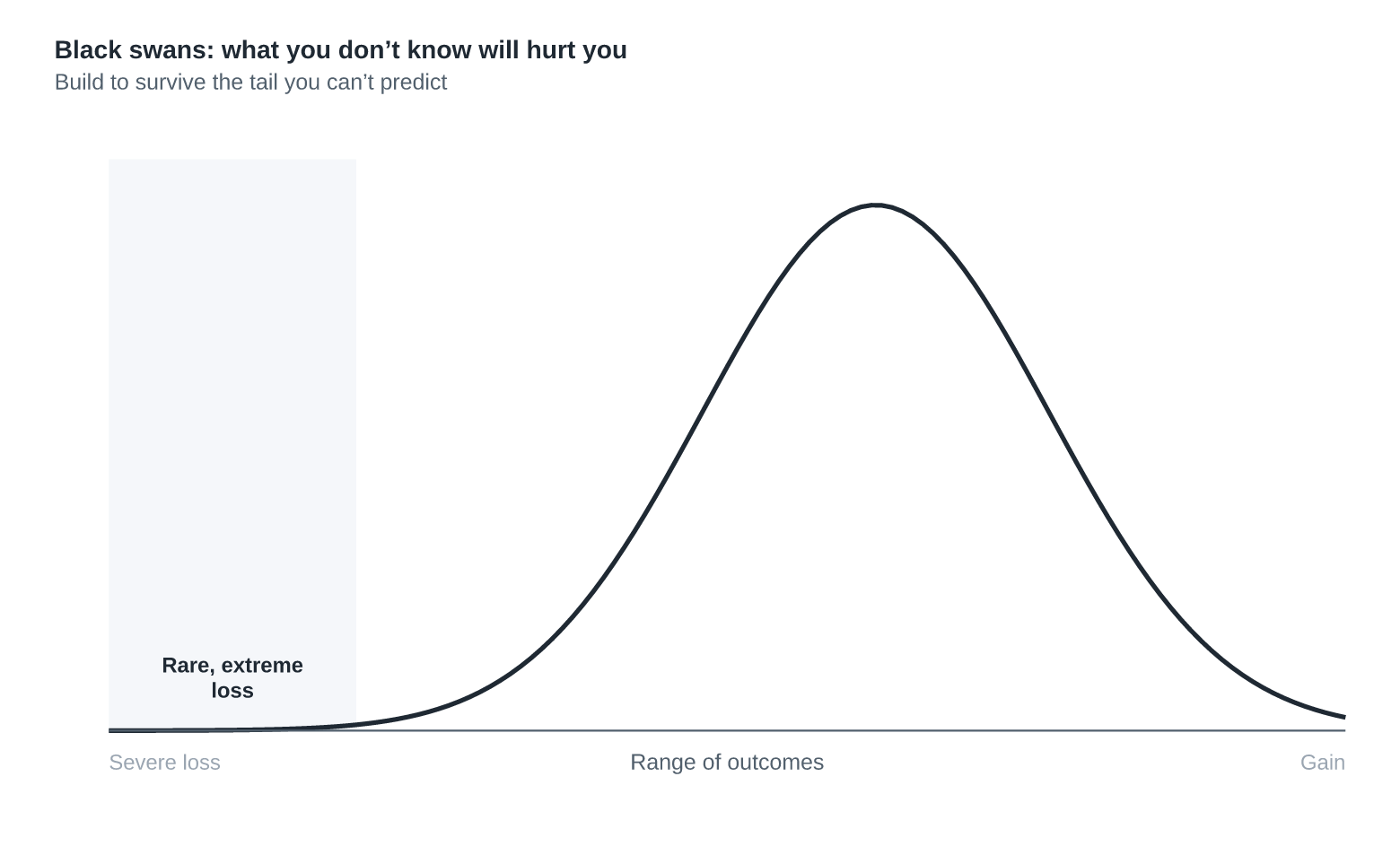
Taleb's framework inverts ordinary risk analysis. Most investors model risk around what has happened before. Taleb asks instead: what would be the consequences of something that has never happened?
A "Black Swan" event has three features:
- It is rare and seems unpredictable beforehand.
- It carries extreme impact — far larger than ordinary events.
- It looks obvious in hindsight, once we have invented a tidy story for it.
For investors, the lesson is structural rather than predictive. You cannot forecast the next shock, so build a portfolio that can survive one. Sensible position sizing, cash reserves and the avoidance of heavy leverage are not timidity — they are the rational response to a world with fat tails. As Taleb puts it, the turkey fed happily for a thousand days has no model for Thanksgiving.
Illustrative example: a fund that "could not lose"
A celebrated fund run by brilliant people once used sophisticated models and very high leverage, and had never lost money — until "impossible" correlations broke down and it nearly destabilised the wider financial system in a matter of weeks. The leverage turned a rare event into an existential one. Survival, not prediction, was the missing discipline.
Educational only — not financial, tax, or investment advice, or a recommendation to take any particular course of action. Any names, figures, and examples illustrate a principle and are historical or simplified; past performance is not a reliable indicator of future results. Rules, tax treatment, and published figures change over time and may not reflect current policy. Wealth Diagnostics provides education and tools for financial advisers and their clients — seek licensed advice for your own circumstances before making any financial decision.